18.3 Million Children. One Country. One Crisis We Cannot Ignore
Somewhere in Zamfara, a nine-year-old girl wakes up before dawn to fetch water. She won’t be going to school today. She didn’t go yesterday either. In fact, she has never sat in a classroom, not once in her short life.
Her name could be Halima. Or Chisom. Or Blessing. The truth is, she has millions of names. Because in Nigeria today, 18.3 million children are out of school, and most of them didn’t choose to be.
Nigeria Holds a Record No Country Should Want
According to UNICEF, Nigeria is now home to the largest number of out-of-school children in the entire world. Not in the region. Not in Africa. In the world.
Let that sit for a moment.
Nearly 1 in every 7 out-of-school children on the planet lives in Nigeria. Only 63% of primary school-age children attend school with any regularity, meaning nearly four in ten Nigerian children are missing out on a foundational education during the most critical years of their development.
And the trajectory is going in the wrong direction. The number of out-of-school children has climbed steadily from roughly 10.5 million in 2013 to 18.3 million in 2024. Decade of reforms. Decade of growth. Yet the crisis deepens.
Why Are So Many Children Not in School?
There’s no single villain in this story. The reasons are layered, systemic, and deeply human.
Poverty is the most immediate barrier.
When a family is choosing between feeding their children and sending them to school, survival wins. School fees, uniforms, textbooks, even in public schools where education is technically free, these costs add up quickly, and for millions of Nigerian households, they are simply out of reach.
Geography and insecurity have made classrooms dangerous. In the North-East, schools have been attacked, shuttered, or abandoned. In Borno, Adamawa, and Yobe states alone, 113 schools were closed due to insecurity. In some local government areas in Zamfara, Kebbi, and Borno, school enrolment rates fall below 40%. For parents watching conflict unfold around them, keeping children home feels like the only way to keep them safe.
Gender bias continues to shut girls out. Particularly in northern Nigeria, cultural expectations still push girls toward early marriage and domestic responsibilities rather than education. The result is a gender gap that robs girls of the tools they need to shape their own futures.
Chronic underfunding has left schools in decay. Nigeria’s 2025 national budget allocates just 7.3% to education, far short of the 15–20% UNESCO recommends for countries committed to universal education. With less than half of that directed toward primary schooling, the consequences are visible in every crumbling classroom: overcrowded desks, untrained teachers, and not a textbook in sight.
What Happens to a Child Who Never Goes to School?
It’s tempting to think of this as an education problem. It’s not. It’s a life problem.
Children who miss out on schooling are more likely to live in poverty as adults. They’re more vulnerable to exploitation, early marriage, and recruitment by criminal or extremist groups. They’re less equipped to navigate health systems, civic life, or the job market. And when they become parents, the cycle often begins again, with their own children.
One uneducated generation doesn’t just hurt itself. It reshapes the next one.
Conversely, the evidence for what education can do is overwhelming. A child who completes primary school is more likely to earn a stable income, make informed health decisions, and raise children who also go to school.
Education doesn’t just change one life. It changes families. Communities. Nations.
The Government Is Not Enough
To be fair, there have been efforts. The Universal Basic Education Commission exists. Laws have been passed. In 2023, the World Bank approved a $700 million loan to Nigeria partly targeting the education crisis. Some states, Enugu, Jigawa, Kano, Kaduna, have moved to allocate over 26% of their own budgets to education in 2025.
But progress has been inconsistent. Policy implementation remains weak. Corruption continues to divert funds. And 18.3 million children are still waiting.
The government cannot solve this alone. And in the meantime, real children are growing up without the basic right to learn.
This Is Why IA-Foundation Exists
At IA-Foundation, we believe that no child should lose their future because of circumstances beyond their control.
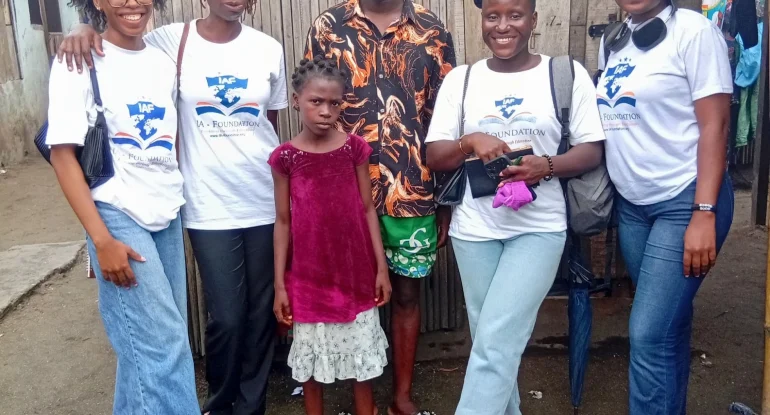
We work directly with out-of-school children, covering the basic educational needs that stand between them and a classroom. School fees. Learning materials. The practical, tangible things that make the difference between a child who goes to school and one who doesn’t.
Our model is simple, because the need is urgent. We don’t wait for policy change. We meet children where they are and walk them back into education, one at a time.
But we can only do this with people who care.
What You Can Do Right Now
If you’ve read this far, you already care, and that matters more than you know.
You can give monthly. Our Monthly Giving Programme lets you support a child’s education consistently, starting from whatever amount works for you. Regular giving means we can plan ahead, commit to more children, and build the kind of stability that one-off donations can’t always provide.
You can share this. Most people don’t know Nigeria holds this record. Awareness changes conversations, and changed conversations eventually change policy and behaviour.
You can volunteer or partner with us. If you’re an organisation, a school, or a professional who wants to do more, we’d love to hear from you.
The Number Is 18.3 Million. But Each One Is a Child.
It’s easy to go numb to statistics. 18.3 million is an abstraction, too large to feel, too vast to fully grasp.
But behind every digit is a face. A name. A kid who would love to read, to learn, to sit in a classroom and discover what they’re good at. A child who deserves the same chances as any other child, anywhere in the world.


Leave A Comment