Blogs

The first thing you notice about Makoko is the water.

It is everywhere, beneath your feet, reflecting the grey morning sky, carrying the weight of thousands of lives lived in a place the rest of Lagos sometimes forgets. Canoes slice through narrow channels. Children peer from doorways that open directly onto the lagoon. The air smells of salt and smoke and something harder to name, the particular scent of a community that has learned, generation after generation, to make a home out of what little the world has offered.

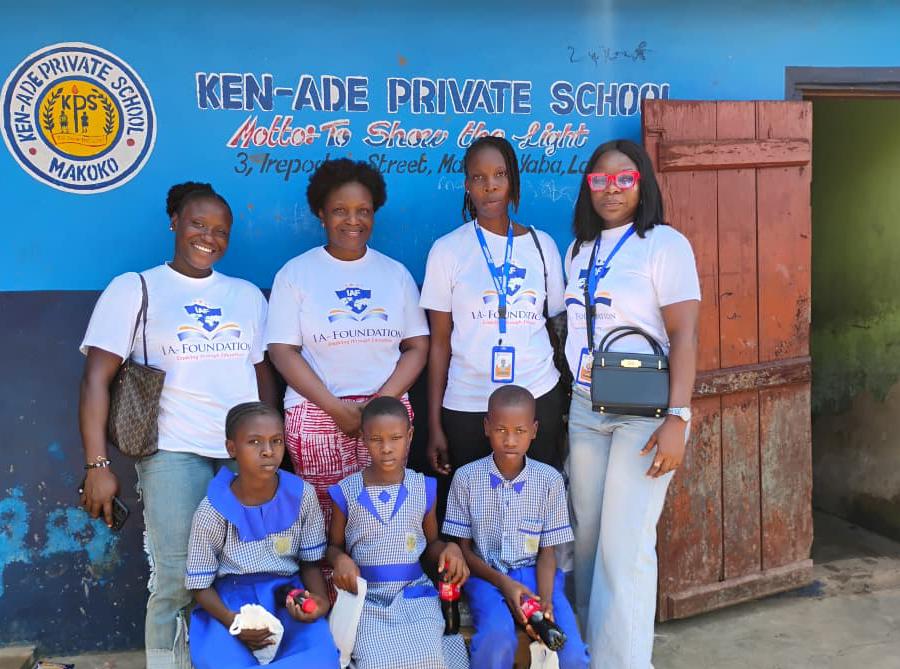
Last Thursday, our team made our way into the heart of this floating community to visit six of our beneficiaries. We came to check in, to listen, and to see for ourselves how the children we serve are faring. What we found, as we always find in these moments, was more than we expected.

Finding Blessing

We will call her Blessing, though names in a place like Makoko carry a kind of defiant poetry all their own.

She is nine years old. She has her mother’s eyes, sharp, watchful, full of quiet intelligence. When we arrived at the small wooden structure her family calls home, she was sitting near the window, a worn exercise book open on her lap. She looked up without surprise, as though she had been expecting us, and gave us the kind of smile that does something to your chest.

A year ago, Blessing had never sat in a classroom. She spent her mornings helping her mother sort fish, her afternoons watching younger siblings, her evenings in the half-dark of a home without consistent electricity. School felt like something that happened to other children, children on the mainland, children whose parents had regular incomes, children who did not live on water.

Then IA-Foundation came.

What It Takes to Get a Child to School

It sounds simple when you say it: getting out-of-school children back into quality education. But nothing about it is simple.

In Makoko, the barriers are not one thing. They are everything at once. They are the cost of a school uniform and the cost of transport across the lagoon and the cost of school materials that a family living at the margins simply cannot afford. They are the belief, sometimes spoken, sometimes simply understood, that a girl’s education is a luxury the family cannot prioritise.

They are the exhaustion of parents working six, seven days a week and still not having enough. They are the absence of schools nearby, and the presence of water between here and anywhere else.

Every child we work with has had to cross all of these barriers. Our team, our community mobilisers, our volunteers, our partner schools, has had to cross them too, alongside these families.

When we sat with Blessing’s mother, she told us something we have heard in different words from many parents in communities like this one. “I always wanted her to go,” she said. “I just didn’t know how.”

That is the gap IA-Foundation exists to close.

The Visit 

We moved from home to home across the morning, visiting all six of our beneficiaries, navigating narrow walkways and the gentle sway of platform boards underfoot. At each stop, we were welcomed with the particular warmth that communities like Makoko extend to those who show up consistently, who do not arrive only with cameras but also with follow-through.

We checked on learning progress. We listened to what was working and what was hard. We distributed materials where they were needed. We answered questions from parents who are invested in their children’s futures in ways that poverty has never been able to fully extinguish.

We met a boy who, few months ago, could barely hold a pencil. He wrote his name for us, slowly and carefully, and then looked up with the expression of someone who has just discovered a superpower.

We met a teenage girl who told us, matter-of-factly, the way young people sometimes say the most significant things, that she wants to be a nurse. She said it without apology. She said it like it was simply a fact about her future that she had decided.

These moments are why we do this work.

Why Makoko, Why Now

Makoko is one of the largest informal waterfront settlements in West Africa, home to an estimated 85,000 to 250,000 people, figures that vary depending on who is counting and how. It sits on the edge of one of Africa’s most prosperous cities, a few kilometres from Lagos Island’s gleaming towers, and yet it exists in a different world entirely: underserved, under-resourced, and under-counted.

The out-of-school crisis in Nigeria is not abstract. Our country has the highest number of out-of-school children in the world. Millions of children children like Blessing, like the boy who wrote his name, like the girl who wants to be a nurse, are growing up without access to the education that could change the entire arc of their lives.

They are not out of school because they lack potential. They are out of school because the system has not yet reached them.

IA-Foundation’s work is about closing that distance.

Coming Back

As we prepared to leave Makoko that Thursday afternoon, Blessing found us again. She had something to show us: a drawing she had made in school, a house surrounded by trees, with a bright sun in the upper corner, the universal grammar of a child’s hope, rendered in coloured pencil.

She pressed it into the hands of one of our team members. “For you,” she said. “Because you came.”

We carried it with us back across the water.

This is what we came to Makoko to find, not to confirm what we already know about poverty and inequity, but to see, up close, what is possible when a child is given a chance. When a community is met with consistency and genuine care. When the gap between where a child is and where they could be begins, slowly and irreversibly, to close.

How You Can Help

The work we do in Makoko, and in communities across Lagos, depends on the generosity of people who believe that every child deserves an education, regardless of where they were born or how they live.

If this story moved you, please consider taking action today.

Donate to directly fund a child’s education at www.ia-foundation.org

Become a Monthly Giver and provide consistent, reliable support to children like Blessing

Share this post and help us reach more people who care about education equity in Nigeria

Together, we can make sure no child is left behind, not in Makoko, not anywhere.

IA-Foundation is a Lagos-based nonprofit dedicated to getting out-of-school children back into quality education.

Learn more about our work at www.ia-foundation.org.

Every June 12, Nigeria pauses to remember. We remember the election of 1993, widely regarded as the freest and fairest in our history,  and the courage of millions of ordinary Nigerians who crossed ethnic, religious, and regional lines to make their voices heard. We remember MKO Abiola. We remember the activists, the protestors, the martyrs who paid with their lives for the democracy we now enjoy.

Democracy Day is a day of pride. But for us at IA-Foundation, it is also a day of honest reckoning.

Because a democracy that leaves millions of its children on the outside of a classroom is an incomplete one.

The Promise Democracy Made

When Nigeria finally restored civilian rule, it wasn’t just a transfer of power. It was a promise to every Nigerian child that their future would be different. That the country would invest in them. That they would have the tools to participate in the nation their parents had fought for.

That promise is written into our laws. Section 18 of the Nigerian Constitution commits the state to free and compulsory basic education. The Universal Basic Education Act of 2004 reinforced it. The Child Rights Act enshrined it. And in October 2025, a Federal High Court in Lagos went further, ruling that the federal government and all 36 states have a legal and enforceable obligation to provide free, compulsory education to every Nigerian child of primary and junior secondary school age.

The law is clear. The courts have spoken. The promise was made.

And yet.

The Reality That Waits Outside the Gates

Today, as Nigeria marks its 27th Democracy Day, more than 18 million children are out of school across the country. A UNICEF report found over 10 million absent at the primary level alone, with another 8 million missing from junior secondary schools. Save the Children puts the wider figure, including those without access to digital learning, at over 28 million children and adolescents.

These are not statistics. These are children whose names we know.

They are children like the ones IA-Foundation works with every day in Lagos, bright, curious, full of potential, who through poverty, displacement, or circumstance found themselves locked out of the education system. Children who never got the memo that democracy was supposed to include them.

Nigeria’s 2026 education budget was actually a drop from the previous year, falling below the UNESCO-recommended 15–20% threshold. In a country where over 60% of the population is under 30, we are investing less in the very generation democracy depends on.

This is not just a policy failure. It is a democratic one.

Education Is the Ballot Paper of the Future

Democracy rests on an informed citizenry. It requires people who can read a ballot, question a manifesto, hold a government to account, build a business, raise a family with dignity.

When we deny a child education, we are not just limiting their future. We are quietly eroding the foundation of the democracy we celebrate today.

June 12, 1993, showed us what Nigerians are capable of when they believe their voice matters, when 14 million people crossed every divide that typically separates them, to participate in something bigger than themselves. That spirit is not dead. But it needs to be fed. And you feed it in classrooms.

This is why IA-Foundation exists.

We believe that getting an out-of-school child back into quality education is not charity. It is democracy in action. It is the most direct way to honour the sacrifice of every June 12 martyr, by ensuring the Nigeria they died for actually reaches its children.

What We Are Asking of This Democracy

On this Democracy Day, we are asking Nigeria’s leaders, federal, state, and local to treat out-of-school children as the democratic emergency they are.

We are asking for budget allocations that match our rhetoric. For implementation of the Universal Basic Education Act that goes beyond circulars and press releases. For the October 2025 court ruling to be treated not as a nuisance but as a mandate.

And we are asking Nigerians, ordinary citizens who understand what it means to fight for something to hold the system accountable. Because democracy is not only exercised at the polls. It is exercised when you refuse to accept that 18 million children being out of school is simply the way things are.

Join Us

At IA-Foundation, we are doing our part, one child, one community, one re-enrollment at a time. But we cannot do it alone.

If you believe every Nigerian child deserves to sit in a classroom, to learn, to dream, and to one day cast their own ballot,  join us.

Volunteer your time. Support our work. Share this message.

Because the truest way to celebrate June 12 is to fight for the children’s democracy.

👉 Learn more and get involved at www.ia-foundation.org

IA-Foundation is a Lagos-based nonprofit working to get out-of-school children in Nigeria back into quality education. We work directly with communities, families, and partners to remove the barriers standing between a child and their classroom.


There is a child in Lagos who walked into a classroom for the first time because someone decided to show up.

Not because they were paid to. Not because it was convenient. But because they believed, deeply, stubbornly, beautifully, that every child deserves a chance to learn.

That someone is a volunteer. And this week, we celebrate them.


What Volunteers’ Week Means to Us

Every year, the first week of June is set aside to honour the millions of people around the world who give their time, skills, and hearts to causes bigger than themselves. It is a moment to pause, to say thank you, and to reflect on the extraordinary difference that ordinary people make when they choose to serve.

At IA-Foundation, Volunteers’ Week is not just a campaign we mark on a calendar. It is a reminder of who we are and how we work. Because the truth is: without our volunteers, we simply could not do what we do.

Our mission, getting out-of-school children in Lagos back into quality education, is urgent, complex, and deeply personal. It requires more than funding. It requires people. People willing to sit with a child who has never held a pencil. People willing to knock on doors in communities where scepticism runs high. People willing to believe in a future that does not yet exist for a child who has been left behind by a system that was supposed to protect them.

Our volunteers are those people.

The Quiet Heroes Behind the Work 

You may not always see them in the spotlight. You may not know their names. But they are there, in the community outreach sessions, in the classrooms, in the planning meetings, in the WhatsApp groups at 10pm discussing how to reach one more family.

They are teachers who give up their weekends. Students who spend their spare hours tutoring children who have fallen behind. Professionals who bring their skills, in communications, finance, logistics, health, to strengthen an organisation striving to make education a reality for every child.

They are mothers and fathers who understand, instinctively, that the child next door deserves the same opportunities their own children have.

They are young people who were once told their dreams were too big, and who now carry the dreams of others.

They show up. Quietly, consistently, powerfully. And with every hour they give, a child’s world gets a little larger.


What Volunteering With IA-Foundation Looks Like

Volunteering with us does not look one way. It never has.

Some of our volunteers are in the field, building relationships with families, helping enrol children, and making sure that the journey from out-of-school to in-school is as smooth as possible. Others work behind the scenes, contributing their expertise to strengthen our programmes, grow our reach, and sharpen our impact.

What they all share is a conviction that no child in Lagos, no child anywhere, should be denied the right to learn.

They bring energy to rooms that need it. They bring calm to situations that are fraught. They bring ideas that none of us would have thought of alone.

And they bring something else too, something harder to name but impossible to miss: hope. A lived, active, contagious hope that things can be different.


To Every Volunteer Who Has Walked With Us

If you have ever given your time to IA-Foundation, whether for a day, a month, a year, or longer, this is for you.

Thank you for believing in the work before the results were visible. Thank you for showing up when it would have been easier not to. Thank you for the conversations you had that we will never know about, the reassurances you gave, the patience you showed, the extra mile you walked.

You have changed lives. That is not a figure of speech. There are children who are in school today, reading, writing, dreaming, because you were willing to serve.

We see you. We honour you. And we are profoundly grateful.

Could You Be One of Them?

Volunteers’ Week is also a moment of invitation.

If you have ever thought about volunteering with us but weren’t sure where to begin, this is your sign. We would love to have you.

Whether you are a student, a working professional, a retiree, or simply someone with time and a willing heart, there is a role for you at IA-Foundation. You do not need a specific background. You need what our volunteers already have: a belief that every child matters

Come and join us. Help us reach more children. Help us build a Lagos, and a Nigeria, where no child is left outside the door of opportunity.

[Get involved today →] https://forms.office.com/Pages/ResponsePage.aspx?id=8FpZCVrSKEOjsGdCFzVgUCToe3huqupBh3X-9HH6cChURUhUVzVLV1daVDFCUlFCNFBZTlZHMVRLWS4u

IA-Foundation is a Lagos-based nonprofit dedicated to getting out-of-school children back into quality education. To learn more about our work or support our mission, visit https://ia-foundation.org/

This Children’s Day, 10 IA-Foundation beneficiaries attended a live cultural performance in Lagos,  and walked away with more than memories.

On Saturday, 30th May 2026, ten children supported by IA-Foundation did something many of them had never done before: they walked into a theatre.

As part of our Children’s Day celebration, the children attended I Wish I Wish — Battle of the Winds at the Main Bowl, WS-Centre/National Theatre, Lagos, a vibrant cultural experience filled with storytelling, creativity, and the kind of magic that only live performance can offer.

For many of them, it was a first.

More Than an Excursion

It would be easy to describe the day as an outing. But what happened at the National Theatre was something deeper than that.

The children, many of whom have faced significant barriers to education and opportunity,  sat in that space and watched stories come alive. They laughed, they asked questions, they leaned forward in their seats. And in those moments, something shifted. They weren’t just watching a performance. They were discovering that they belonged in spaces like that one.

That is what IA-Foundation set out to do this Children’s Day: not just celebrate children, but expand what they believe is possible for themselves.

Changing Perspective, Changing Lives

At IA-Foundation, our work centres on getting out-of-school children in Lagos State back into quality education. But we know that education is more than a classroom. It is exposure. It is an experience. It is the quiet confidence that grows in a child when they realise the world has a place for them.

When a child from an underserved community steps into a national theatre, sits where everyone else sits, and watches the same show as everyone else, that is a statement. You belong here. Your dreams are valid. The world is bigger than your current circumstances, and you are not too small for it.

The excitement in the children’s eyes, the questions they asked on the way home, the laughter they carried with them, all of it reminded us why this work matters.

Every Child Deserves More Than a Chance to Survive

Children’s Day is a reminder that childhood itself is worth protecting and celebrating. Not just the idea of it, but the lived experience: joy, wonder, discovery, and the freedom to dream.

Too many children in Lagos are growing up without that. They are bright, curious, and full of potential, but circumstances have narrowed their world. Our job, as an organisation, is to widen it.

This Children’s Day, we took ten children one step closer to believing in their own potential. And we will keep going, because every child deserves not only an education, but a life full of experiences that inspire hope, confidence, and the courage to dream big.

Want to help more children like these access education and life-changing experiences? Support IA-Foundation today.

An Education-focused Non-Governmental Organisation,Ibironke Adeagbo
Foundation has described the Oyo state kidnapping case as an attack on every child’s right.

Recall that Gunmen riding motorcycles descended on three schools almost simultaneously: Baptist Nursery and Primary School in Yawota, Community Grammar School, and L.A. Primary School in Esiele and on Sunday, May 17, a video had gone viral showing the beheading of one of the abducted teachers, Michael Oyedokun — a gruesome public message from the gunmen about the fate that awaits those still in captivity.

The Founder, Ibironke Adeagbo made this known in a statement issued to newsmen on Thursday evening.

Ibironke said the school attackers are holding in captive the nation’s future for attacking schools.

While commiserating with the affected families, she called on federal and state authorities, security agencies, community leaders, and every Nigerian to demand urgent, decisive, and sustained action.

Adeagbo also prayed for the freedom of those in captive, adding that a nation with paucity of child’s protection is a gambler.

“What happened in Oyo is an attack on that mission. It is an attack on every child’s right to sit in a classroom and learn, to dream, to become. When schools are targeted, the future of a nation is what the attackers are really holding for ransom.

“We stand with the families of Ahoro-Esinele. We mourn with them. We call on federal and state authorities, security agencies, community leaders, and every Nigerian who believes in the future of this country to demand urgent, decisive, and sustained action.

“We pray for the safe return of every abducted child, every teacher, every staff member still in captivity. And we refuse to accept that this is simply how things are. A nation that cannot protect its children is gambling with everything.” She said.

In suggesting ways to ameliorate the recurrent of such event, The Founder asked the Federal Government to leverage on Safe Schools Declaration Act in protection of its children.

She lamented over the pattern of attacks, condemnations, investigations and repeat of such.

“Nigeria is a signatory to the Safe Schools Declaration, a commitment to protect education during conflict and insecurity. And yet the attacks continue. The Nigerian Senate, as recently as November 2025, ordered a full investigation into why funds set aside for the Safe Schools programme had apparently failed to protect children.

“The pattern is clear: attacks happen, condemnations follow, investigations are announced, and then the cycle begins again, clearly there is a correlation between the level of out of school children and insecurity. We neglect out of school children at our peril.” Founder said

Imagine sending your child to school on a Friday morning and never seeing them come home.

That is the reality thousands of Nigerian families now live with. On May 15, 2026, it became a reality for families in Ahoro-Esinele, a quiet community in the Oriire Local Government Area of Oyo State.

Gunmen riding motorcycles descended on three schools almost simultaneously: Baptist Nursery and Primary School in Yawota, Community Grammar School, and L.A. Primary School in Esiele. They came in the early hours, during morning assembly, when children were gathered and most vulnerable. They shot sporadically. Teachers, students, and the Vice Principal, Mrs. Alamu Folawe, were dragged away into the forests. An Assistant Headmaster, Mr. Adesiyan, was killed during the attack. An Okada rider was shot dead for refusing to hand over his motorcycle to the fleeing assailants.

By Sunday, May 17, a video had gone viral showing the beheading of one of the abducted teachers, Michael Oyedokun — a gruesome public message from the gunmen about the fate that awaits those still in captivity.

The community of Ahoro-Esinele is in mourning. So is the rest of Nigeria.

A Pattern That Has Gone On Too Long

What happened in Oyo is horrifying. It is also, painfully, not new.

Since the abduction of 276 schoolgirls from Chibok in April 2014,  a crime that shocked the world and gave Nigeria a wound it has never fully healed from, the targeting of schools has become one of the most disturbing features of the country’s security crisis. In December 2020, over 300 boys were taken from a boarding school in Kankara, Katsina. In February 2021, students were seized in Kagara and Jangebe. In March 2024, gunmen on motorcycles abducted 287 pupils from a government secondary school in Kaduna. In November 2025, 25 schoolgirls were kidnapped from a school in Kebbi State, and just three days later, 303 children and 12 teachers were taken from St. Mary’s Catholic School in Niger State, in what became the single largest school abduction in Nigeria’s history.

Between January 2023 and late 2025 alone, at least 816 pupils were taken in 22 separate school attacks. Since 2014, the cumulative toll has reached over 2,400 children, a staggering number that does not even account for all the children who never returned.

And now, Oyo.

What makes the Oriire attack particularly significant is where it happened. School kidnappings have historically been concentrated in the north, in Borno, Niger, Kebbi, Katsina, Zamfara, and Kaduna. That was already a national crisis. But Governor Seyi Makinde of Oyo State himself warned that terrorists displaced by military operations in the north-west were moving southward, filling gaps wherever security presence is thin. The bandits in Oriire, he said, are believed to be members of armed groups pushed out of northern territories and now finding new terrain in the south-west.

No part of Nigeria is immune. That is the message being written in the blood of children.

Why Children? Why Schools?

It is a question that should not need asking, but the answer reveals the cold logic behind these crimes.

Schools are deliberate targets, not incidental ones. Security analysts have noted that armed gangs see schools as strategic: they attract media attention, create maximum emotional impact on families, and most critically, they generate ransom. Between July 2023 and June 2024 alone, kidnappers across Nigeria demanded approximately ₦11 billion in ransom payments. For criminal networks, children are currency.

The ransom economy feeds on desperation, on the love of parents who will do anything to bring their children home. It feeds on the slow pace of security response in remote, underserved communities, places like Ahoro-Esinele, where the Chairman of Oriire LGA himself admitted that the area is far from the nearest police station and difficult to access quickly.

The attackers in Oyo reportedly fled into forests bordering the Old Oyo National Park, terrain that is forested, vast, and nearly impossible to quickly comb. By the time military and police units arrived, the assailants had vanished.

What This Means for Education 

Beyond the immediate horror, there is a quieter damage being done, one that threatens to outlast any single attack.

When schools become targets, children start associating learning with danger. Parents in communities near Oriire have begun keeping their children home. The Oyo State Universal Basic Education Board ordered the immediate closure of all primary schools in Oriire and three neighbouring local government areas, Surulere, Oyo East, and Olorunsogo, as a precautionary measure.

Closed schools. Empty classrooms. Children who should be learning, at home and afraid.

Education advocates have repeatedly warned that insecurity around schools does not just disrupt learning at the moment, but it erodes trust in the education system itself. When a parent has to weigh their child’s safety against their future, many will choose safety. Enrolment drops. Attendance falls. Girls, often the most vulnerable, are frequently withdrawn first and permanently.

For a country already grappling with one of the largest out-of-school child populations in the world, this is not a minor disruption. It is a deepening wound in an already struggling system.

The Response Cannot Be Business As Usual 

Nigeria is a signatory to the Safe Schools Declaration, a commitment to protect education during conflict and insecurity. And yet the attacks continue. The Nigerian Senate, as recently as November 2025, ordered a full investigation into why funds set aside for the Safe Schools programme had apparently failed to protect children.

The pattern is clear: attacks happen, condemnations follow, investigations are announced, and then the cycle begins again.

This cannot continue.

The Oyo attack must be a turning point, not another headline that fades. Security agencies must pursue the Oriire abductors with every available resource until every child and teacher is safely returned. Families deserve answers, not press statements.

But beyond this immediate crisis, there must be a structural rethinking of how Nigeria protects its schools. More security deployment in rural communities. Intelligence-sharing between states, especially as armed groups move across boundaries. Community early warning systems. And above all, real accountability for how public funds designated for school safety are spent.

Our Commitment 

At IA-Foundation, our mission is to ensure that every child has access to education, not just in theory, but in practice, safely, and without fear.

What happened in Oyo is an attack on that mission. It is an attack on every child’s right to sit in a classroom and learn, to dream, to become. When schools are targeted, the future of a nation is what the attackers are really holding for ransom.

We stand with the families of Ahoro-Esinele. We mourn with them. We call on federal and state authorities, security agencies, community leaders, and every Nigerian who believes in the future of this country to demand urgent, decisive, and sustained action.

We pray for the safe return of every abducted child, every teacher, every staff member still in captivity.

And we refuse to accept that this is simply how things are.

A nation that cannot protect its children is gambling with everything.

IA-Foundation works to keep out-of-school children in education by providing support for their basic educational needs. If you believe every child deserves to learn in safety and dignity, consider supporting our work.

Nigeria continues to face one of the world’s largest out-of-school children crises, with millions of children deprived of access to quality education. Northern Nigeria remains the most affected region, where poverty, insecurity, child labour, and social barriers continue to prevent children from attending school.

Recently, a major intervention by the European Union (EU) brought renewed hope to vulnerable children in Jigawa State as 411 out-of-school children were empowered through educational and vocational support programmes.

This initiative highlights the urgent need for collaborative efforts in tackling Nigeria’s education crisis and restoring hope to vulnerable communities.

The EU Intervention in Jigawa State

The programme, implemented by Save the Children International (SCI) with support from the European Union, focused on empowering out-of-school children and youths across Gwaram, Babura, and Kafin Hausa Local Government Areas of Jigawa State.

The beneficiaries received:

  • Literacy and numeracy education
  • Vocational and life skills training
  • Income-generating support kits
  • Empowerment tools for self-reliance
  • Certificates upon completion of training

The initiative was carried out under the Accelerating Basic Education and Livelihood Opportunities for Children and Youth (ABEP) project, designed to reduce the growing number of out-of-school children in northern Nigeria.

The programme also partnered with agencies including the National Directorate of Employment (NDE) and the State Agency for Mass Education (SAME) to ensure sustainable implementation and community impact.

Why This Matters

For many children in northern Nigeria, education is often interrupted by poverty, displacement, insecurity, or the need to support family income. As a result, thousands of children are forced into street hawking, domestic labour, or early marriage instead of classrooms.

Interventions like this are important because they do more than provide temporary assistance, they create pathways to long-term empowerment.

By equipping vulnerable children with practical skills and educational support:

  • Families can improve their economic stability
  • Young girls become less vulnerable to early marriage
  • Communities experience reduced poverty and social exclusion
  • Youths gain opportunities for self-reliance
  • The cycle of illiteracy can gradually be broken

Behind every statistic is a child with dreams, potential, and the desire for a better future. Programmes like this give many children a second chance at hope and dignity.

Nigeria’s Growing Out-of-School Children Crisis

Nigeria currently has one of the highest numbers of out-of-school children globally, with northern states carrying a significant share of the burden. Several factors continue to fuel the crisis, including:

  • Economic hardship
  • Insecurity and displacement
  • Lack of access to quality schools
  • Gender inequality
  • Cultural and social barriers
  • Poor learning infrastructure

Without urgent intervention, millions of children risk being permanently excluded from education and economic opportunities.

This is why government agencies, international organisations, NGOs, and community stakeholders must continue working together to expand access to education and child empowerment programmes.

The Role of NGOs and Development Organisations

Non-governmental organisations and education-focused charities continue to play a critical role in reducing the number of out-of-school children across Nigeria.

Through school sponsorships, advocacy campaigns, mentorship programmes, vocational training, and educational support initiatives, organisations are helping vulnerable children return to learning and rebuild their futures.

At IA-Foundation, we strongly believe that every child deserves access to quality education regardless of their background or circumstances. Education remains one of the most powerful tools for breaking the cycle of poverty and creating lasting social change.

The Way Forward

While empowering 411 children is a commendable achievement, millions of children across Nigeria still remain outside the classroom. Sustainable progress will require:

  • Increased investment in education
  • Stronger child protection systems
  • Community awareness campaigns
  • Improved access to rural education
  • More vocational and digital skills programmes
  • Partnerships between governments, NGOs, and development agencies

Ending the out-of-school children crisis in Nigeria will require collective responsibility and long-term commitment from all stakeholders.

Conclusion

The European Union’s empowerment of 411 out-of-school children in Jigawa State represents more than just a social intervention, it is a reminder that meaningful change is possible when organisations invest intentionally in children and education.

By combining literacy, vocational training, and economic empowerment, the initiative provides vulnerable children with the opportunity to learn, grow, and build a better future.

As advocates for education and child development, we must continue supporting initiatives that give every child a chance to succeed and thrive.

Somewhere in Zamfara, a nine-year-old girl wakes up before dawn to fetch water. She won’t be going to school today. She didn’t go yesterday either. In fact, she has never sat in a classroom, not once in her short life.

Her name could be Halima. Or Chisom. Or Blessing. The truth is, she has millions of names. Because in Nigeria today, 18.3 million children are out of school, and most of them didn’t choose to be.

Nigeria Holds a Record No Country Should Want

According to UNICEF, Nigeria is now home to the largest number of out-of-school children in the entire world. Not in the region. Not in Africa. In the world.

Let that sit for a moment.

Nearly 1 in every 7 out-of-school children on the planet lives in Nigeria. Only 63% of primary school-age children attend school with any regularity, meaning nearly four in ten Nigerian children are missing out on a foundational education during the most critical years of their development.

And the trajectory is going in the wrong direction. The number of out-of-school children has climbed steadily from roughly 10.5 million in 2013 to 18.3 million in 2024. Decade of reforms. Decade of growth. Yet the crisis deepens.

Why Are So Many Children Not in School?

There’s no single villain in this story. The reasons are layered, systemic, and deeply human.

Poverty is the most immediate barrier.

When a family is choosing between feeding their children and sending them to school, survival wins. School fees, uniforms, textbooks, even in public schools where education is technically free, these costs add up quickly, and for millions of Nigerian households, they are simply out of reach.

Geography and insecurity have made classrooms dangerous. In the North-East, schools have been attacked, shuttered, or abandoned. In Borno, Adamawa, and Yobe states alone, 113 schools were closed due to insecurity. In some local government areas in Zamfara, Kebbi, and Borno, school enrolment rates fall below 40%. For parents watching conflict unfold around them, keeping children home feels like the only way to keep them safe.

Gender bias continues to shut girls out. Particularly in northern Nigeria, cultural expectations still push girls toward early marriage and domestic responsibilities rather than education. The result is a gender gap that robs girls of the tools they need to shape their own futures.

Chronic underfunding has left schools in decay. Nigeria’s 2025 national budget allocates just 7.3% to education, far short of the 15–20% UNESCO recommends for countries committed to universal education. With less than half of that directed toward primary schooling, the consequences are visible in every crumbling classroom: overcrowded desks, untrained teachers, and not a textbook in sight.

What Happens to a Child Who Never Goes to School? 

It’s tempting to think of this as an education problem. It’s not. It’s a life problem.

Children who miss out on schooling are more likely to live in poverty as adults. They’re more vulnerable to exploitation, early marriage, and recruitment by criminal or extremist groups. They’re less equipped to navigate health systems, civic life, or the job market. And when they become parents, the cycle often begins again, with their own children.

One uneducated generation doesn’t just hurt itself. It reshapes the next one.

Conversely, the evidence for what education can do is overwhelming. A child who completes primary school is more likely to earn a stable income, make informed health decisions, and raise children who also go to school.

Education doesn’t just change one life. It changes families. Communities. Nations.

The Government Is Not Enough

To be fair, there have been efforts. The Universal Basic Education Commission exists. Laws have been passed. In 2023, the World Bank approved a $700 million loan to Nigeria partly targeting the education crisis. Some states, Enugu, Jigawa, Kano, Kaduna, have moved to allocate over 26% of their own budgets to education in 2025.

But progress has been inconsistent. Policy implementation remains weak. Corruption continues to divert funds. And 18.3 million children are still waiting.

The government cannot solve this alone. And in the meantime, real children are growing up without the basic right to learn.

This Is Why IA-Foundation Exists

At IA-Foundation, we believe that no child should lose their future because of circumstances beyond their control.

We work directly with out-of-school children, covering the basic educational needs that stand between them and a classroom. School fees. Learning materials. The practical, tangible things that make the difference between a child who goes to school and one who doesn’t.

Our model is simple, because the need is urgent. We don’t wait for policy change. We meet children where they are and walk them back into education, one at a time.

But we can only do this with people who care.

What You Can Do Right Now

If you’ve read this far, you already care, and that matters more than you know.

You can give monthly. Our Monthly Giving Programme lets you support a child’s education consistently, starting from whatever amount works for you. Regular giving means we can plan ahead, commit to more children, and build the kind of stability that one-off donations can’t always provide.

Start giving today

https://ia-foundation.org/monthly-giving/

You can share this. Most people don’t know Nigeria holds this record. Awareness changes conversations, and changed conversations eventually change policy and behaviour.

You can volunteer or partner with us. If you’re an organisation, a school, or a professional who wants to do more, we’d love to hear from you.

The Number Is 18.3 Million. But Each One Is a Child.

It’s easy to go numb to statistics. 18.3 million is an abstraction, too large to feel, too vast to fully grasp.

But behind every digit is a face. A name. A kid who would love to read, to learn, to sit in a classroom and discover what they’re good at. A child who deserves the same chances as any other child, anywhere in the world.

That child is waiting.

Let’s not make them wait any longer.

There’s a moment every teacher knows. A question hangs in the air, and somewhere in the room, a child’s hand shoots up, eager, certain, alive with the thrill of knowing something. It’s a small moment. But it means everything.

Now imagine a child who never gets that moment.

Not because they’re not smart enough. Not because they don’t care. But simply because they were never in the room.

Across Nigeria and beyond, millions of children wake up every morning without a school to go to. Not millions in the abstract, not millions as a statistic scrolling past on your phone,  millions of real children with real names, real dreams, and real potential that the world is quietly allowing to go to waste.

At IA-Foundation, we refuse to accept that.


The Out-of-School Crisis: What the Numbers Don’t Tell You

Nigeria is home to the largest population of out-of-school children in the world, over 10 million, by the most conservative estimates. That figure is staggering. But numbers have a way of numbing us.

What the numbers don’t tell you is what it looks like on the ground.

It looks like a 9-year-old girl named Amaka, who helps her mother sell tomatoes at the market each morning because the family can’t afford both food and school fees. She’s quick with sums, she can calculate change faster than most adults,  but nobody in her world has ever told her that this makes her good at mathematics.

It looks like a 12-year-old boy in a rural community two hours from the nearest secondary school, who has already accepted that education simply isn’t something that happens to people like him.

It looks like potential, quietly dimming.


Why Children Fall Out of School — And Why It’s Not Their Fault

When people think about out-of-school children, they often assume something went wrong, that a child dropped out, gave up, or fell behind. The truth is far more complicated, and far less fair.

Children leave school, or never enter it, for reasons that have everything to do with circumstance and nothing to do with character.

Poverty is the most obvious driver. When a family is choosing between school fees and dinner, dinner wins. It has to. But poverty isn’t the only force at work. Distance matters, communities without nearby schools see attendance collapse, especially for girls. Safety matters, families in conflict-affected areas pull children home to keep them alive. Early marriage, child labour, disability, and the simple absence of functioning school infrastructure all play a role.

These aren’t excuses. They’re realities. And addressing them requires more than goodwill, it requires strategy, presence, and sustained commitment.


What IA-Foundation Actually Does

We don’t just talk about the crisis. We work inside it.

IA-Foundation operates at the intersection of community trust and systemic change. We work directly with families, local leaders, and the children themselves to understand why a child is out of school, and then we do something about it.

That might mean providing financial support so that school fees are no longer a barrier. It might mean working with a community to address the cultural or logistical factors keeping girls at home. It might mean connecting a child with an alternative learning pathway when the traditional school system has failed them.

Every child’s situation is different. That’s why we don’t do one-size-fits-all.

What we do, always, is show up.


Education Is Not a Privilege. It’s a Right.

There’s a version of this conversation where education gets framed as a gift , something fortunate children receive, something charitable organisations bestow. We reject that framing entirely.

Education is a right. It’s enshrined in international law. It’s the foundation of every other right a child will exercise for the rest of their life. When a child doesn’t go to school, they’re not missing out on a privilege. They’re being denied something they are owed.

Reclaiming that right, fighting for it, funding it, building the structures that protect it, is not optional. It’s urgent.


The Ripple Effect Nobody Talks About

Here’s something worth sitting with: when you help one child return to school, the benefits don’t stop with that child.

Studies consistently show that educated children go on to raise healthier, better-educated families of their own. Communities with higher school enrolment see lower rates of poverty, better health outcomes, and greater civic participation. An educated girl, in particular, becomes a force multiplier for change in her community.

The child who gets to raise their hand in class today is the mother, engineer, teacher, or leader who transforms her community tomorrow.

That’s not sentiment. That’s evidence.


Here’s How You Can Help

IA-Foundation is powered by people who believe that every child deserves a chance. If that’s you, here’s where you come in:

  • Share this post. Awareness is the first step. Every share brings more eyes to a crisis that doesn’t get enough attention.
  • Your contribution, whatever its size, goes directly toward getting children back into education. No child should be out of school because of money.
  • Whether you have skills in education, communications, fundraising, or community outreach, we want to hear from you.
  • Talk to your networks. Ask questions. Demand better. Governments and institutions respond to pressure from informed, engaged citizens.


A Final Word

Amaka is still at the market. For now.

But she doesn’t have to stay there. Not if enough people decide that her potential matters,  that her future is worth fighting for, worth funding, worth showing up for.

At IA-Foundation, we’ve already decided. We hope you’ll join us.

IA-Foundation is a non-profit organisation committed to getting out-of-school children back into education. Learn more about our work or get involved at http://www.ia-foundation.org

Amara is nine years old. She wakes before sunrise every morning, helps her mother fetch water, then spends her day minding her younger siblings while the school bell rings somewhere in the distance. She can write her name,  just about, and count to twenty. But Amara has never sat in a classroom. She has never held a report card or solved a maths problem on a chalkboard.

Amara is not a statistic. But she is part of one,  and it’s a statistic the world keeps trying to look away from.

250M+

Children worldwide currently out of school

~60%

Are girls, disproportionately affected across Sub-Saharan Africa

1 in 5

Children of primary-school age in developing regions never enrol at all

These numbers are enormous. And when numbers get enormous, they stop feeling real. They become policy language, donor reports, footnotes in speeches. Meanwhile, children like Amara keep growing up, smart, curious, capable, but shut out of the one thing that could open every door.

That is exactly why IA-Foundation exists. Not to manage a crisis from a distance, but to walk into communities, sit with families, and do the patient, unglamorous, necessary work of getting children back into learning.

Why Do Children Fall Out of School in the First Place?

If you’ve never had to pull a child from school, it’s easy to assume the reasons are simple, poverty, neglect, indifference. The truth is far more tangled, and far more human.

Poverty is the root, but it branches in many directions.

For many families, keeping a child in school is a genuine sacrifice. School fees, uniforms, exercise books, the cost of transport, these are not small things when a household is surviving on the edge. Older children, especially girls, are often needed at home to contribute economically or to care for younger siblings. It is not heartlessness. It is survival arithmetic.

Distance is underestimated.

In rural areas, the nearest school can be five, eight, ten kilometres away. A long walk for an adult is a dangerous journey for a seven-year-old, particularly in communities where roads are unpaved, seasons are harsh, and girls face real safety risks travelling alone.

The school itself can be the problem.

Overcrowded classrooms. Undertrained teachers. A curriculum taught in a language the child doesn’t speak at home. For children who have already fallen behind, returning to a formal classroom can feel humiliating. The system doesn’t always know how to welcome them back.

“The question is never whether these children can learn. The question is whether we have built spaces worthy of them.”

What IA-Foundation Actually Does

There are organisations that write about the problem. IA-Foundation is one that works on it, on the ground, in the community, with the child at the centre.

Our approach starts with identification. Before a child can be helped, they have to be seen. We work with community liaisons, local leaders, and parents to find the children who have slipped through the cracks, the ones who are old enough for school but aren’t there. The ones hiding in plain sight.

From there, the work is about trust. Trust with parents who are understandably sceptical. Trust with children who may associate school with failure or embarrassment. Trust with communities who have been promised things before and seen nothing change.

We do not parachute in solutions. We build them locally, flexible learning spaces, bridge programmes for children who need to catch up, support systems for families who need more than just a classroom to make attendance sustainable. Every intervention is shaped by the people it serves. 

The Cost of Doing Nothing

It is worth saying plainly: the cost of leaving these children without education is catastrophic, not just for them, but for all of us.

A child who doesn’t complete basic education is dramatically more likely to live in poverty as an adult, more vulnerable to exploitation, more likely to experience poor health outcomes, and less able to participate in the economic and civic life of their community. Multiply that by millions, and you have a generational crisis that compounds itself.

Education is not a luxury. It is the infrastructure on which everything else rests. Health. Stability. Economic growth. Democracy. All of it depends on people who were taught to think, to read, to reason. When we leave children behind, we are dismantling that infrastructure brick by brick, slowly, quietly, and at enormous future cost.

“Every child who falls through the cracks today is a bridge we failed to build for tomorrow.”

What Change Actually Looks Like

Change, in this work, doesn’t always look dramatic. It looks like a mother who finally says yes. It looks like a boy who used to spend his afternoons doing nothing now sitting in a circle with other children, sounding out words he didn’t know last month. It looks like a teenage girl who was told school was not for her discovering, quietly but powerfully, that she was wrong.

These are small victories. We don’t pretend otherwise. But they are real ones, and they ripple. A child who learns to read becomes an adult who can read to their own children. A girl who stays in school becomes a woman who insists her daughter does too. Progress in education is slow, but it is also durable. It echoes forward through generations.

That is what IA-Foundation is building, not just school attendance today, but a culture of learning that survives beyond any single programme or donation cycle.

How You Can Be Part of This

If you’ve read this far, something in you already cares. That matters. Caring is where everything starts.

You don’t have to be a philanthropist or a development economist to make a difference. The truth is, the most powerful thing most of us can do is choose to show up in some way, however small, for a child we’ll never meet.

Join the Movement

Every contribution, of money, time, or voice, puts a child closer to a classroom. Here’s where you can start:

Donate Today

Volunteer with Us

Share This Story

Amara, the girl at the beginning of this story, is fictional. But she is also entirely real, because there are millions of children just like her, right now, waiting for someone to decide they are worth the effort.

At IA-Foundation, we have made that decision. We hope you’ll make it with us.

By IA-Foundation | Because every child’s story deserves a next chapter.


There is a particular kind of silence that follows a child who has never been to school.

It isn’t the peaceful quiet of a lazy Sunday morning. It’s the silence of a door that was never opened. Of a question that was never asked. Of a life that learned, early on, to shrink itself down, to want less, expect less, become less, because the world made it clear that some children are not part of the plan.


That silence is real. It lives in communities across the world, in the eyes of children who have never held a textbook, never written their own name, never sat in a classroom and felt the small, extraordinary thrill of understanding something for the first time.

At IA-Foundation, we hear that silence. And we refuse to let it be the final word.


There Are Millions of Them. And Most of Us Don’t Know.


Currently, as you read this, there are an estimated 250 million children out of school worldwide.

Two hundred and fifty million.

Children who are bright and curious and full of the same wild potential as any child. Children who laugh at the same things, who dream the same dreams, who deserve the same future, but who have been failed by poverty, by geography, by conflict, by systems that were never built with them in mind.


They are not invisible because they don’t matter. They are invisible because it’s easier to look away.

IA-Foundation exists to look toward them instead.


What Does It Mean to Be Out of School?


It means more than missing lessons.

It means growing up believing that learning is for other people. It means watching the world move forward while you stay still. It means arriving at adulthood without the tools to build the life you deserve, and being told, quietly or loudly, that this is simply the way things are.

It is one of the quietest forms of injustice in our world. And it is entirely, completely, preventable.


The Moment Everything Changes


Let us tell you about a girl,  we’ll call her Fatou.

Fatou was ten years old when she first walked through the doors of one of our community learning hubs. She had been out of school for three years. She sat in the back row, arms crossed, eyes low. She had learned the hard way,not to raise her hand. Not to hope too loudly.

The first week, she barely spoke.

The second week, she asked a question.

By the third month, she was the one answering them.


Something had shifted. Not because of magic. Not because of a miracle. But because someone had finally looked at Fatou and said: you belong here. This seat is yours. Your mind matters.


That is what IA-Foundation does. We give children their seat back.


How We Do It — And Why It Works


Our work is built on a simple but powerful belief: no child should have to earn the right to an education.

We go to where children are, not where it’s convenient for us to be. We build community learning hubs in areas where schools are too far, too expensive, or simply not there. We recruit and train local educators who come from the same communities as the children they teach, because trust is the foundation of everything. We design flexible programmes that meet children where they are, not where the system expects them to be.


And we stay. Because the children who have been let down the most are often the ones who need the most consistency, someone who shows up on the hard days, not just the easy ones.


This Is Personal. For All of Us.


You might be reading this from a home with books on the shelves. You might have a memory of a teacher who believed in you, a classroom where something clicked, a qualification that opened a door.

Most of us take these things for granted. Not because we are ungrateful, but because we never had to imagine life without them.


The children IA-Foundation works with don’t have that luxury. But they have the same hearts, the same minds, the same hunger to understand the world. They are not less than. They have simply been given less.


That is something we can change. That is something you can be part of changing.


What You Can Do Today


You don’t need to be wealthy. You don’t need to be an expert. You just need to decide that these children are worth showing up for.


Share this post. The first step to change is awareness. The more people who understand what out-of-school children are facing, the harder it becomes to ignore.


Support our work. Every contribution, whatever you can give, goes directly into programmes that reconnect children with education. You could be the reason a child picks up a pen for the first time.


Spread the word. Talk about this. In your community, on your social media, at your dinner table. These children don’t have a platform. You do.


Volunteer. If you have skills in teaching, communications, fundraising, technology, or just showing up with heart, we want to hear from you. There is always room for people who care.


A World Where No Child Is Left Behind


We know that vision sounds ambitious. Maybe even impossible.

But we have seen what happens when a child who was written off begins to believe in themselves. We have watched quiet, withdrawn children become confident young people. We have heard mothers cry with relief because their daughter is finally learning to read. We have seen entire communities shift when they realize their children have a future, a real one, not a watered-down version.


Change is possible. It is happening. Right now, in the learning hubs, in the communities, in the eyes of children who are finally starting to understand that the world belongs to them too.

All it takes is for enough of us to decide it matters.

It matters.


IA-Foundation is a non-profit organisation dedicated to bringing education to out-of-school children. Join us. The children are waiting.


When a Child Is Ready to Learn but the World Says No

Millions of children in Nigeria are out of school despite their desire to learn. Discover the realities they face and how education NGOs are restoring hope.

Introduction: The Child Who Stayed Behind

Every morning, the road to school fills with energy, children in uniforms, laughter in the air, the quiet excitement of a new day of learning.

But not every child joins that walk.

Some stand at a distance, watching. Not because they don’t want to go.
But because something beyond their control is holding them back. This is the quiet reality for millions of children across Nigeria.

The Hidden Story Behind Out-of-School Children

The term “out-of-school children” is often used in reports and headlines. But behind it are real lives, children with dreams, questions, and potential waiting to be discovered.

Many of them are eager to learn, yet face barriers such as:

  • Family responsibilities that come too early
  • Limited access to nearby schools
  • Lack of basic learning materials
  • Social and environmental challenges

These are not children without ambition. They are children without access.

What Happens When a Child Is Left Out
When a child is denied education, the impact goes far beyond the classroom. A missed school day becomes missed opportunities.
Curiosity slowly fades into uncertainty.

Confidence gives way to limitation.

Over time, the absence of education shapes not just a child’s present, but their entire future.

Where Change Begins

Despite these challenges, hope is not lost.

Across communities, education-focused organizations are working quietly but powerfully to change this narrative. One such organization is IA-Foundation.

Their work is rooted in a simple belief:
Every child deserves access to quality education.

Through community engagement and targeted support, they help:

  • Reintegrate children back into school
  • Provide essential learning materials
  • Support families navigating difficult circumstances
  • Create safe and encouraging learning environments

For many children, this is the turning point.

From Uncertainty to Possibility
There is something powerful about a child who is given a second chance. A child once unsure of their future begins to dream again.
A classroom becomes more than a place to learn, it becomes a place of hope.

These transformations may not always make headlines, but they are happening every day, quietly reshaping lives and communities.

Why Education Changes Everything

Education is more than reading and writing. It is the foundation for:

  • Confidence and self-worth
  • Opportunity and independence
  • Stronger, more resilient communities

When a child is educated, the impact extends far beyond the individual, it touches families, communities, and future generations.

A Shared Responsibility
The challenge of out-of-school children in Nigeria is complex, but not impossible to address.

It requires awareness.
It requires commitment.
It requires people who believe that every child matters.

Organizations like IA-Foundation continue to lead this effort, one child, one story, one future at a time.

Conclusion: The Children Still Waiting

Some children are still standing at the sidelines, watching others walk toward a future they long for.

They are ready to learn.

Ready to grow.

Ready to become.

All they need is the opportunity.

write a message

write a message