Tolu is nine. (Tolu is a composite character, drawn from stories we hear often.) Every morning she watches children in clean uniforms walk past her gate. Her mother loves her and can’t find the money for a bag, a pair of shoes and “extras” she assumes the school will demand. So Tolu stays home, minding her little brother and helping at the stall.
It feels like a small, temporary decision. For many families, it is the start of a very long one.
Why this choice matters
UNICEF estimates that about 18.3 million children in Nigeria are out of school. Behind that number are children like Tolu, and parents who are making hard choices with limited options. Nobody here is a bad parent. But a child at home, however loved, is missing things that a classroom gives.
What a public school gives that home cannot
- A structured education that is free at the basic level. Nigeria’s Universal Basic Education Act provides for free, compulsory basic education, covering primary school and junior secondary. In practice, schools may still ask for small levies, and costs like uniforms and books are real. But enrolling is far cheaper than most parents expect, and it is worth asking the school directly what applies.
- Trained teachers and a full curriculum. A parent can teach a child to count and read. Few parents can also teach English, mathematics, science and civic education across nine years of basic education. Teachers are trained to do it, and children move through a curriculum that prepares them for the next level.
- Recognised records and certificates. A school leaving certificate and results are what open the door to secondary school, trades, apprenticeships and university. Without them, a capable child has nothing to show for what they know.
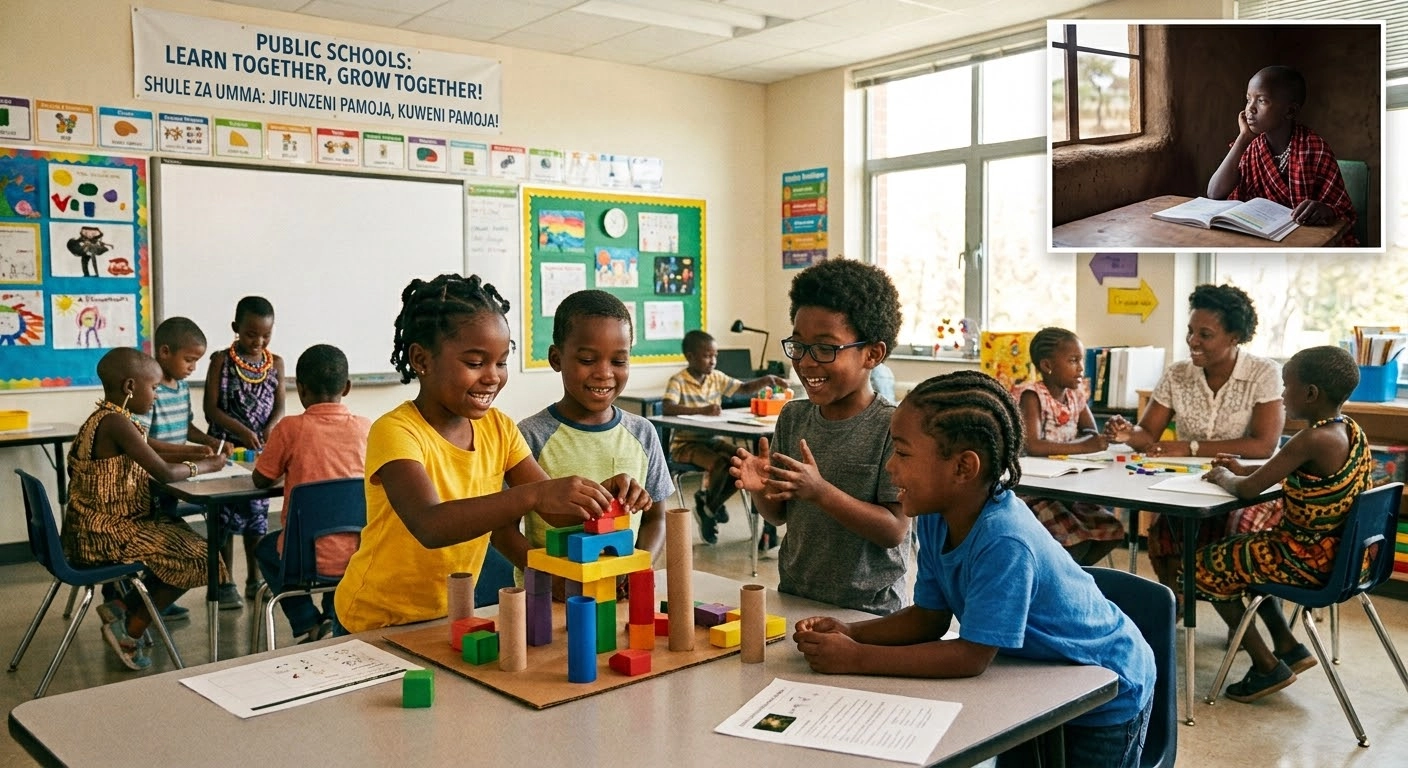
- Friends, confidence and social skills. Children learn to share, argue, lead, lose and try again among other children. A classroom teaches them how to work with people who are not family.
- A safer, more predictable day. A child in school is supervised, occupied and surrounded by adults who are responsible for them. A child left at home or on the street all day has far less protection.
- A real chance at a different future. Education is one of the strongest routes out of poverty. Each extra year of schooling improves a child’s chances of earning more, staying healthy and raising healthy children of their own.
“But public schools have problems”
They do. Some classrooms are crowded. Some schools lack resources. We won’t pretend otherwise. But the answer to an imperfect school is rarely no school at all. Parents who stay involved make a real difference. Visit the school, meet the teacher, ask about your child’s progress, and join the parents’ association. A present parent in an imperfect school will usually do more for a child than a perfect plan that never starts.
How to get your child enrolled
- Visit your nearest public school and speak with the head teacher.
- Ask what documents are needed (birth records are helpful, but ask about alternatives if you don’t have one).
- Ask exactly what levies or costs apply, and whether any support is available.
- Enrol your child, even if the school year has already started. Many schools will place a child at the right level.
Every child deserves a seat
Tolu’s story doesn’t have to end at the gate. With one conversation, one visit and one form, a child can go from watching to belonging.
At IA-Foundation, we work to bring out-of-school children in Nigeria back into quality education. If you know a child who is not in school, or you want to help us reach more of them, visit ia-foundation.org today.